
Blended Wing-Body Underwater Gliders (BWBUGs)
|OVERVIEW|SITREP|PRODUCTS|S&T|FEED|
|UPDATED: 3 OCT 2025
A Blended Wing Body Underwater Glider (BWBUG) is an autonomous underwater vehicle (AUV) that combines principles of blended wing body aerodynamics with underwater glider technology. This integration creates a unique design that maximizes hydrodynamic efficiency, operational flexibility, and stealth, making the BWBUG a highly versatile, multi-mission platform for extended operations.
DESIGN
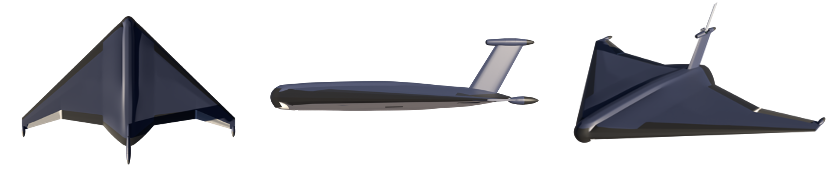
The term "blended wing body" refers to a vehicle shape that seamlessly merges the fuselage and wings into a unified structure. This design is typically seen in aerospace engineering, but has been adapted for underwater vehicles to maximize hydrodynamic efficiency and achieve a high lift-to-drag (L/D) ratio, which is key for energy efficiency, payload capacity, and stealth.
- Efficient Hydrodynamics: The smooth, streamlined shape reduces drag and allows the vehicle to glide more efficiently underwater with minimal power consumption, enabling BWBUGs to operate for months without the need to recharge.
- Increased Payload Capacity: The vehicle's high L/D ratio and internal configuration allow it to accommodate larger payloads compared to traditional AUVs. This enables the integration of various sensors, and possibly a warhead or torpedo, making it versatile for both reconnaissance and kinetic operations.
- Energy Efficiency: The vehicle's streamlined design and innovative propulsion system enable it to operate for extended periods and over long distances while conserving energy for managing onboard payloads.
GLIDING MECHANISM
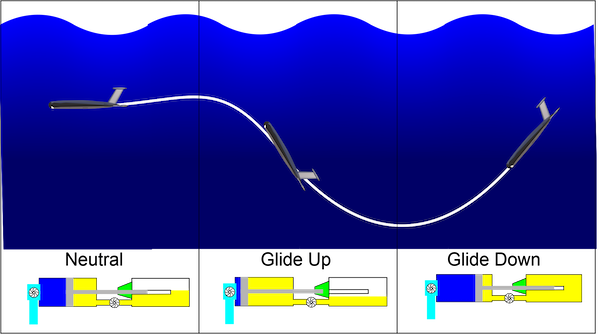
Like conventional gliders, BWBUGs rely on a variable buoyancy system to control their depth in the water column. Rather than relying on traditional propulsion systems, like propellers or thrusters, the vehicle adjusts its buoyancy to dive and rise in a characteristic up-and-down, sawtooth pattern.
STEALTH
Without active propulsion systems, BWBUGs have a significantly reduced acoustic signature, making them harder to detect by passive sonar systems. This feature is crucial for stealth operations, as it allows the vehicle to operate undetected in hostile or contested environments.
APPLICATIONS AND CAPABILITIES
BWBUGs are highly versatile and can be employed in a wide variety of defense roles:
- Intelligence, Surveillance, and Reconnaissance (ISR): The BWBUG's long endurance and stealth make it ideal for persistent surveillance of both littoral and open ocean regions.
- Seabed Mapping and Oceanographic Research: Equipped with advanced sensors and imaging sonars, BWBUGs can conduct detailed seabed surveys, environmental data collection, and oceanographic research.
- Offensive Mine Warfare: The BWBUG's long endurance and ability to remain undetected make it an ideal platform for structuring mobile minefields within the water column.
- Underwater Communication and Relay: BWBUGs can function as communication relays or data nodes, transmitting key intelligence gathered from submerged sensors or other assets.
- Anti-Submarine Warfare (ASW): BWBUGs can silently patrol vast underwater regions for extended periods, and could potentially be armed with torpedoes, making them potent ASW platforms. When deployed in large numbers or in conjunction with seabed sensors and other autonomous vehicles, BWBUGs could present a significant challenge to adversary submarines.
- Subsea Strike: The BWBUG's ability to carry heavyweight payloads, such as torpedoes or other munitions, opens up new possibilities for kinetic strikes against seabed infrastructure, such as undersea pipelines, cables, or other strategic seabed assets that are crucial to adversary operations.
CHALLENGES AND CONSIDERATIONS
Despite its promising design and functionality, there are challenges to the operational success of BWBUGs:
- Payload Capacity: While BWBUGs offer increased payload capacity compared to traditional AUVs, they are still constrained by factors such as size, weight, and energy consumption. For certain mission types, larger or more power-hungry payloads may limit the BWBUG's operational range and endurance.
- Control and Navigation: The gliding mechanism and minimal propulsion can make precise control and maneuvering difficult, particularly in complex underwater environments.
- Energy Management: Although BWBUGs are highly energy efficient compared to conventional AUVs, they still rely on batteries or other energy reserves, which can be depleted. Energy recovery or charging systems, such as those based on solar or thermal power, may be needed to extend the vehicle's mission life. Ongoing research in this area may lead to further improvements.
DEVELOPMENT
In the early 2000s, the Office of Naval Research, in partnership with Scripps Oceanographic Institute, Woods Hole, SAIC, Bluefin Robotics, and the applied research labs of Penn State and the University of Texas, Austin, developed the Liberdade-class blended wing body underwater glider (BWBUG), a high-endurance underwater glider capable of accommodating large payloads for use in marine mammal observation or ASW hold-at-risk operations.
- Two prototypes were constructed – the XRay and its more capable successor, the ZRay.
- The ZRay had a lift to drag ratio of 35-to-1, and was reportedly capable of carrying payloads of 800kg, reaching speeds of five knots, and conducting sustained operations for up to six months.
- Other than scattered mentions in scientific publications, very little has been published regarding the ZRay.
- There are references to ZRay's potential role in U.S. Navy PLUSNets (Persistent Littoral Underwater Surveillance Networks) - autonomous, undersea ASW networks comprised of fixed seabed sensors and AUVs, and deployed in coastal regions to track adversary diesel-electric submarines.
- The DARPA/Northrop Grumman Manta Ray program, a BWBUG test platform for developing "a new class of long duration, long range, payload-capable UUVs" may be a reconstitution, or simply a beneficiary, of Liberdade research. Alternatively, U.S. research efforts may have "gone black" and formed the basis for classified research and development.
Several countries have studied or are actively pursuing BWBUG designs.
- In 2020, Australian marine engineering company Ron Allum Deepsea Services unveiled Deep Ray, a vehicle developed under a contract with Australia's Defence Science and Technology Group (DST).
- Scientists from Japan, Germany, India, and South Korea have conducted independent scientific research on BWBUGs.
- People's Republic of China (PRC) scientists have demonstrated a keen interest in BWBUGs, having published dozens of papers on the subject since 2013, and developed biomimetic prototypes based on Manta Ray flapping propulsion.
-- PRC scientists have experimented with conventional gliders for many years, achieving several high-profile records for both depth and endurance, with many deployments to both the South China Sea and Indian Ocean.
-- Scientists have explored using conventional gliders as acoustic sensor nodes by equipping them with one or two single vector hydrophones.
ROLE IN KINETIC OPERATIONS
Given their heavyweight payload capacity, BWBUGs could be weaponized and used to structure large scale, mobile minefields within the water column, or to engage in subsea strike operations.
▶︎ ASuW and ASW:
The potential for BWBUGs in offensive mining is significant.
- Current offensive mining doctrine among advanced navies is predicated on the use of immobile bottom mines deployed in shallow littoral areas and chokepoints.
- Fitted with target detection technologies and heavyweight warheads or torpedoes, blended wing underwater gliders could be used to create a collaborative pod of mobile mines to interdict and/or restrict the movement of enemy shipping, surface warships, and submarines operating within deep, open ocean regions, or to carry out strikes against deepsea infrastructure.
- A mobile minefield would pose a vexing mine countermeasures (MCM) dilemma, as current MCM operations focus on detecting, identifying, and neutralizing bottom or moored mines deployed in relatively shallow (90 meters or less) water.
- While purpose-built to kill surface and/or submerged targets, the mere presence of mobile mines operating within the water column could generate significant operational or strategic effects through the imposition of psychological costs on enemy forces.
▶︎ Subsea Strike:
The BWBUG's ability to carry heavy munitions would enable kinetic strikes against seabed targets.
- Targets may include strategic infrastructure like pipelines, communication cables, or undersea military installations.
- Kinetic payloads could be carried externally using the REMORA payload system developed by Areté.
- The REMORA attaches to the hull via high-strength vacuum force, remaining neutrally buoyant during transit and becoming negatively buoyant upon release, all with minimal impact on hydrodynamics or endurance.
- A custom release mechanism would enable the BWBUG to self-deploy the payload using a high-frequency, through-hull ACOMMS signal.
- As REMORA can be scaled up to accommodate large payloads, a BWBUG could accommodate multiple REMORAs in order to deploy clusters of kinetic effectors against seabed targets.
|OVERVIEW|SITREP|PRODUCTS|S&T|FEED|
In the United States, BWBUG research and development has resumed under the guise of two known defense programs: the DARPA/Northrop Grumman Manta Ray, and the General Atomics Ranger.
DARPA/Northrop Grumman
Manta Ray
Northrop Grumman’s Manta Ray, developed in collaboration with DARPA, is a long-duration AUV capable of extended operations by harvesting energy from within the water column.
- The vehicle features a hydrodynamically efficient design, optimized for energy conservation, modular payload integration, and seabed hibernation.
- It can be deployed in forward environments, operate with minimal human intervention, and conduct a wide range of missions such as ISR, seabed warfare, or environmental monitoring.
- Northrop Grumman successfully completed full-scale in-water testing in 2024, marking a significant step toward persistent, distributed undersea presence.
Northrop Grumman's Manta Ray program has led to the development of a novel underwater recharging and communication system, The Mission Unlimited Unmanned Underwater Vehicle (UUV) Station, that enhances AUV operational endurance and autonomy.
- The station is designed to be deployed from a ship, sink to the seafloor, and anchor itself.
- It integrates innovative energy harvesting, efficient power transfer, as well as data communication technologies to address the critical challenge of sustaining long-duration underwater missions without the need for human intervention.
- Northrop Grumman has partnered with Seatrec, a renewable energy technology company, to develop a recharging station that integrates the company's thermal energy harvesting system, which exploits the ocean's natural temperature gradients to generate electricity.
- This would allows the Manta Ray (as well as other vehicles) to recharge batteries autonomously while in-situ, significantly extending its mission duration without the need for surface recovery.
To facilitate reliable power transfer between the Manta Ray and its recharging station, Northrop Grumman has developed a self-insulating electrical connector, NiobiCon.
- Unlike traditional connectors that rely on seals to prevent water ingress, NiobiCon utilizes the unique properties of niobium.
- When exposed to water, niobium forms a thin, passive oxide film that acts as an insulator.
- Upon mating the connector, this film is disrupted, allowing electrical current to flow.
- When disconnected, the film reforms, preventing corrosion and ensuring long-term reliability in harsh underwater environments.
In addition to energy harvesting, Manta Ray employs an innovative data communication method using "data bubbles."
- These are small electronic devices that store data collected during the vehicle's operations.
- Once the Manta Ray surfaces or reaches a designated location, it releases these data bubbles, which ascend to the surface and transmit the stored information via satellite communication links.
- This system enables efficient data transfer without the need for the vehicle to remain at the surface for extended periods, thereby maintaining its stealth and operational capabilities.
Promotional images indicate that the vehicle is fitted with two maneuvering thrusters located on the wingtips, which would greatly enhance the vehicles maneuverability, as well as its ability to travel for extended periods in the horizontal plane. The vehicle will also be able to anchor to the seafloor and hibernate for extended periods.
General Atomics
Ranger
Little is known of the General Atomics BWBUG, Ranger. There is currently no publicly available information, however concept images were on display at the 2024 Sea-Air-Space exhibition.
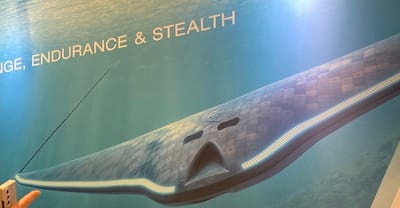
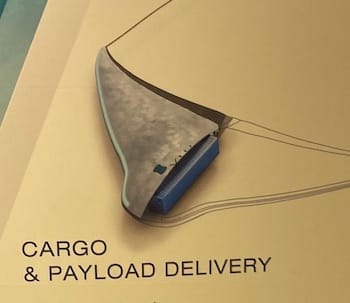
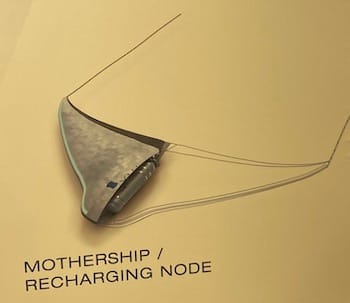
[Photos via Strikepod Systems, obtained with permission of General Atomics.]
G-Ray
Referred to as a next generation blended wing glider, this vehicle is comparable in size to ZRay (wingspan of 22 ft/6.7 meters), with advances in electronics, sensors, and batteries, and a payload capacity of approximately 8 ft³, which can be released through the top or bottom of the vehicle. G-Ray is scheduled to be fabricated by the end of 2025, with at-sea testing beginning in 2026.
China continues to demonstrate interest in BWBUGs, including their use in ASW or seabed warfare.
- In 2024, scientists affiliated with Northwestern Polytechnical University (NPU) recently published a paper in Ships and Offshore Structures that explores the potential for BWBUGs to be used in a combat role, including seabed strike.
- In 2024, NPU and the PLA Navy Submarine Academy scientists developed an algorithm methodology to optimize the deployment of a swarm of BWBUGs for purposes of passive acoustic surveillance.
- In 2022, scientists from the NPU School of Marine Science and Technology explored the use of enhanced particle swarm optimization (EPSO) to analyze the anti-submarine warfare (ASW) search capability of a BWBUG, resulting in a cumulative detection probability of 66.7%.
|OVERVIEW|SITREP|PRODUCTS|S&T|FEED|
‣ ⿻ S&T Brief: PRC Scientists Explore Blended Wing Transmedia Vehicle - 3 December 2025
‣ ⿻ S&T Brief: PRC Scientists Develop Small Manta Ray UUV - 15 October 2025
‣ ⿻ BWBUG Clandestine Deployment of Seabed Infrastructure - 30 September 2025
‣ ⿻ S&T Brief: PRC Scientists Study Disc-Shaped Underwater Glider - 17 September 2025
‣ ⿻ S&T Brief: PRC Hydrodynamic Study of Manta Ray Gliding - 2 July 2025
‣ ⿻ S&T Brief: A Twin Hybrid Autonomous Underwater Vehicle (THAUV) - 21 April 2025
‣ ⿻ S&T Brief: BWBUG ASW Search Optimization - 6 January 2025
‣ ⿻ S&T Brief: PRC Scientists Analyze 3D BWBUG Pod Optimization - 30 August 2024
‣ ⿻ Defense Contractors Unveil Blended Wing UUVs - 11 April 2024
‣ ⿻ S&T Brief: PRC Scientists Study BWBUG "Blockade Capability" - 5 April 2024
‣ PRC Research on Blended Wing Underwater Gliders - 28 April 2022
‣ Mind the Gliders - Overview - 18 February 2022
‣ Preview: Mind the Gliders - 19 January 2022
|OVERVIEW|SITREP|PRODUCTS|S&T|FEED|
|OVERVIEW|SITREP|PRODUCTS|S&T|FEED|
|INTEL FEED|
|2024|2023|2022|2021|2020|2019|
2025
‣ Manta Ray: DARPA’s Deep-Dive
(Grey Dynamics, 3/5/2025)
‣ Huge Manta Ray Underwater Drone Looks Like A Docked Star Wars Spaceship
(The War Zone, 6/21/2024)
‣ China plans to expand ‘manta ray’ submersible fleet with eye on reconnaissance roles
(SCMP, 6/9/2024)
‣ The Pentagon Created a New Kind of Underwater Predator: The Mysterious Manta Ray
(Popular Mechanics, 4/11/2024)
Manta Ray High-Endurance Underwater Drone Unveiled
(The War Zone, 4/8/2024)
‣ Northrop Grumman Completes Assembly of Manta Ray Uncrewed Underwater Vehicle
(Northrop Grumman, 4/8/2024)
‣ As the Glider Community Grows, so do Gliders
(Teledyne Marine, 03/29/2024)
‣ In-Water Tests for DARPA Manta Ray Scaled Prototype
(DARPA, 27 September 2023)
‣ Voices from DARPA Podcast Episode 61: Manta Ray: Unleashing Robotic Undersea Endurance
(DARPA, 10/20/2022)
‣ Engineering Imitating Life
(Northrop Grumman, 09/26/2022)
‣Manta Ray: Mastering the Deep
(Northrop Grumman, 9/22/2022)
‣ MAE team selected for $3.2 million energy-harvesting underwater vehicle project
(NC State, 02/25/2022)
‣ Manta Ray – Breaking the UUV Mold
(DARPA, 12/20/2021)
‣ DARPA Building An Energy-Harvesting Submarine That Never Runs Out Of Power
(Forbes, 2/12/2021)
DARPA Selects Performers to Advance Unmanned Underwater Vehicle Project
(DARPA, 2/5/2021)
‣ DARPA Selects Lockheed Martin for “Manta Ray” extra-large UUV program
(Naval Post, 2/24/2020)
